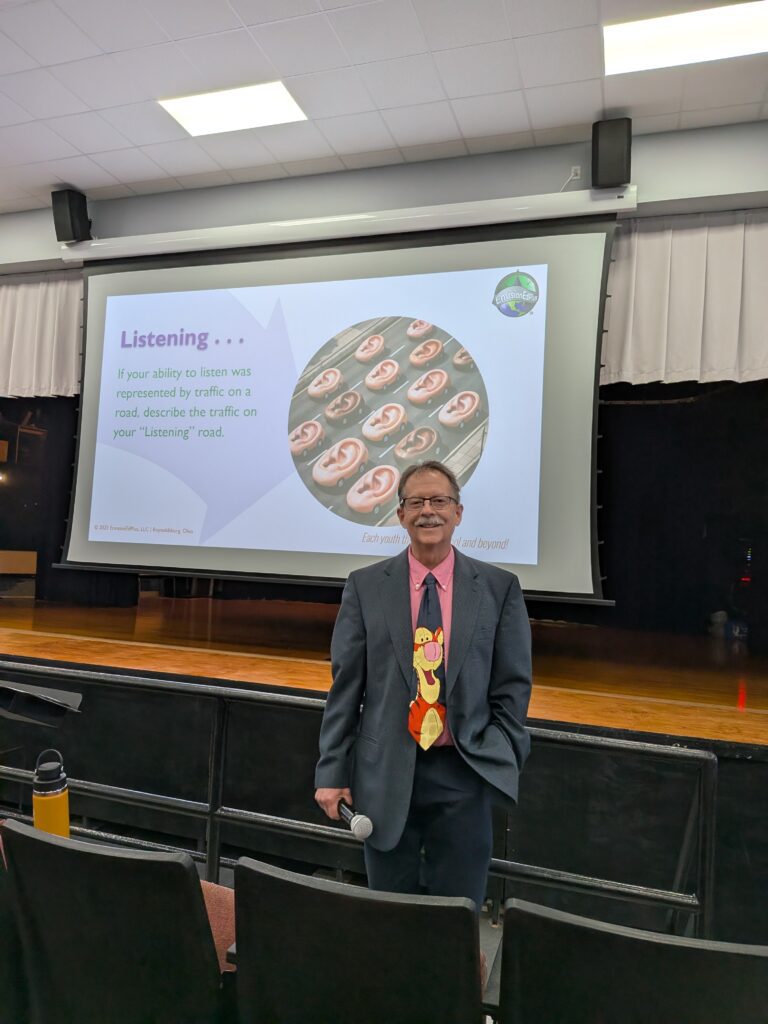
Last month, we completed the second day of our professional development series with Edison Local School District. In partnership with Still-Light Seminars, we explored processing time in conversation and the power of nonverbal communication through presentations and small-group sessions.
Did you know? Our view of others in conversation is often shaped by what we don’t hear. In fact, 60-70% of our impressions of another person come from their non-verbals: posture, facial expressions, eye contact, and body language. When we pay attention to nonverbals during a conversation, we may pick up on messages beyond the words being spoken. Particularly, in a situation where eye contact is minimal or posture appears to be sluggish, in this instance, the context of what one is saying can be overlooked, as their nonverbal cues may unintentionally affect how their message is received.
This is where lag time or the processing gap comes into play. As one listens to another, they must decode, interpret, connect, and evaluate, all before responding. Lag time, or processing time, is the difference between how fast a person can talk and how fast the other can listen. Our ability to listen and take in information is significantly higher than our ability to talk. This means we can have more time to process what we are hearing, making intentional listening especially important during conversation.
One staff member shared an important takeaway from the session: “Listening better can help build our relationships with our colleagues, students, and their parents.”
Staff had the chance to break out into small groups throughout the day to identify triggers during processing and strategies to navigate challenges that can come up during conversation. Here are five takeaways to show active listening:
- Nod your head to stay in their head!
- If you cross, it’s a loss. Keeping your posture open means not crossing your arms or legs, which can help you appear more open to conversation.
- Smile and maintain eye contact.
- Learners retain more information when an educator or presenter uses strong gestures and hand movements.
- Changing your tone can encourage listeners to connect with what you are saying, rather than hearing a flat tone of voice.
Small changes in how we listen and communicate can make a meaningful difference in the relationships we build with those around us. As you move forward in your work as a youth-serving professional, take the time to listen and meaningfully engage with those around you!